


MY LIFE AS A CODER (SPECIAL)
D/MX 919781, 1952-54
Dennis Mills

|

|
|
|
Preface
The account below was prompted by radio and TV programmes on the subject broadcast a few months ago, and more particularly by reading G Elliott and H Shukman, Secret Classrooms: a Memoir of the Cold War, St Ermin's Press, 2002/3. Detailed references are made to the latter in the Appendix. I have been helped by still having my Certificate of Service, which lists all the dates of my being drafted to various ships and barracks. Also useful have been photographs and mementos some of which appear here as illustrations. Telephone conversations with other ex-coders have been very helpful.
Preliminaries
In 1949, my last year at school, I got a place at Nottingham University to read geography with history and was able to take it up straight away, having been given three years' deferral of National Service. In the autumn of 1951 I had to begin thinking about life after graduation. I was very pressed for time and knew I would continue to be so down to the time of my final exams. The easy solution was to put long-term career plans on one side and to get on with National Service without any thought of further deferrals. By this time National Service had become a two-year commitment.
Partly for the latter reason, I felt that to turn up at the 'medical' with no ideas as to which service and branch I wanted to enter was not a sensible strategy. One heard a great deal of anecdotal evidence, but I must have come across a few recruiting leaflets. One of these made it plain, contrary to the generally accepted view, that it was possible to do National Service in the Royal Navy (in fact I now know that naval National Servicemen were only two percent of the total). I didn't fancy the Army, being repelled by the thought of route marches in full kit. I wanted to travel further afield than the many RAF stations near my home. The Navy seemed to be attractive by comparison, mysterious to a young man brought up far from the sea, with only little experience of sea travel, and no relatives or friends who had served in the Navy during the recent war. The challenge of the unknown had to be taken up!
To get into the Navy I had to agree to do a minimum of three weeks' RNVR training before starting National Service. About November I filled in a form volunteering to become an ordinary seaman in the Humber Division of the RNVR. In the first week of 1952 I went to the Divisional HQ, a small ship moored on the Humber in Hull. I must have gone through a very perfunctory joining process, as all I can remember is the colour vision test on woollen strands of primary colours plus green, the issue of uniform appropriate to the status of ordinary seaman and the allocation to me of the service number HD 887.
Early in July 1952 I reported to the National Service recruitment centre in Lincoln. The first stage was the 'medical' in the main hall, with different specialists for different parts of the body. The hearing test was very perfunctory, only requiring the doctor and recruit to shut themselves in a soundproof box, whereupon the doctor whispered words like 'scissors' and one had to guess what they were. I managed to pass this test, but it was far from detecting that I would not be a very good radio operator.
The eyesight tests were also rudimentary, but included the usual elementary reading test. On being asked to read the smallest type, I read out A Brown and Co, Printers, Hull, from the bottom of the page. The doctor then snatched the paper out of my hand and squinted at it, saying that he had never seen that line!
I then met the presiding officer, who asked me which service and branch I would like to join. When I said I was going into the Navy anyway as an ordinary seaman RNVR, he started contradicting what I knew to be in Queen's Regulations, or something like that. A long argument ensued until a stray beam of insight crossed his mind. First he went through a drawer full of untidy leaflets until he found what he was looking for and read it; then he referred back to the form I had filled in earlier that day.
'Ah', he said, 'I see that you did French and Latin in the sixth form'. As I agreed, I wondered what wily stratagem was being deployed to break the deadlock, then it came: 'Do you think you could learn Russian?' It was long past my lunch time, and I was hungry and annoyed, so I said I would try if it meant I could go into the Navy, to which he agreed.
RNVR training.
During the interview, I had carefully avoided pointing out that I had not yet done my minimum of three weeks' training, but that soon came about, in August-September 1952. I reported in uniform to HMS Indefatigable at Portland, and as instructed did not take any civilian clothes with me. Getting dressed correctly in such strange gear was beyond me. I fully expected to be picked up by the 'redcaps' at one of the London stations as I passed through, or by the naval police at Portland, but the journey was entirely uneventful.
The 'Indefat' was an aircraft carrier of 26,000 tons launched in 1942, scrapped in 1956, and had seen service in the Far East. It still had a long dent in the 'island' superstructure where it had been hit by a 'kamikaze' aircraft. The ship had no aircraft on board, having been converted to a training school for RNVR and RN ratings. Six hundred of us were housed in the upper hangar, extra ventilation being provided by keeping open the forward lift shaft on which aircraft were normally transported up to the flight deck. We slung our hammocks in serried ranks both sides of a main gangway, from which we were screened by our lockers. |

|
Compared with what we had heard about Army square-bashing and the courses at the Naval Gunnery School, the regime was fairly benign, although we did have to rise at 5.45am and the food was nothing to write home about. We RNVR ratings were given a sensible mix of instruction, which included some seamanship lectures and practical experience of manning boats (whalers and cutters), naval history and customs, elementary navigation, PT and some instruction on marching and drilling on the flight deck. We had Sunday 'divisions', a church service on this deck.
We also did our share of 'working part of ship', what the Army calls 'fatigues'. I remember scrubbing a strategic piece of deck, which every officer in the ship seemed to cross while I was trying to get on with my work; and chipping rust off an AA gun turret ready for someone to paint it. There were also domestic jobs to be done in our own mess. The sea air, the exercise and the early reveilles made us tired and I fell asleep in the White Ensign Club in Weymouth one week-end evening. Fortunately, one of my messmates roused me in time for us to hurry back to the 'liberty boat'.
When we had joined the ship, it had been stationed out in Portland harbour and was having its bilges cleaned out, which meant that it spent most of the next fortnight listing to port or starboard as the work unbalanced the trim.
On the second Sunday we set sail overnight down the Channel to Devonport. The sea was dead calm, but we noticed a change in temperature which made our single blankets (I still have mine) seem inadequate. The entrance to Plymouth Harbour and the short passage up the Tamar to Devonport was an unforgettable experience. We lined the deck in traditional fashion and as the ship twisted and turned in its gentle course an ever-changing vista came into sight. After returning from Devonport, I had a long wait for call-up papers to arrive - in fact, I sent the Admiralty a reminder, as I wanted to get demobbed before the academic year 1954-55 began. During this wait I spent some time with the EUP Teach Yourself Russian - I knew I was not a born linguist from my French and Latin results and it seemed sensible at least to learn something about the Cyrillic alphabet.
First impressions
Eventually, on 27 October I reported to Victoria Barracks, Portsmouth (or HMS Victory I) to begin my National Service as a probationary coder special (as distinct from coder educational, a man trained in codes and ciphers but also working as a schoolmaster with junior ratings). There was at least one other ex-RNVR recruit, John Carter, an Old Etonian; and probably Robin Hope, also from Eton. It appears that the public schools had naval cadet forces which fed men into the Navy via the RNVR.
We had three weeks at Vicky Barracks, which were spent on a shore-based variation of the three RNVR weeks. Different elements included PT on the beach at Southsea (running on pebbles is hard work!), the usual film about venereal diseases during which one of us fainted (also as usual), and anti-gas training.
When we were able to march with reasonable precision, we went through the streets of Portsmouth to see HMS Victory (ship), one of the most important of the rites of passage into the Navy.
There was an introduction to night-time guard duties, in which we patrolled the boundary between the male barracks and the Wren barracks - the Navy obviously took seriously the threat marauding Wrens might pose for 'sprogs' such as us!
Our class (44 NA 1) had joined just too late to transfer to a Joint Services School for Linguists (JSSL) and had to be occupied until the next entry date came round on 2 February 1953. First, a fortnight was spent at the Chatham depot (HMS Pembroke) where we were installed in a reasonably comfortable converted air raid shelter. We were put through an elementary course in codes and ciphers at the signal school about half a mile up Brompton Road, to which we marched twice a day. As no one was resident there, we again had guard duties to do and I remember a really cracking frost when the guard-issue duffle coat was very welcome, but the torch would have been insufficient to repel boarders.
During this time I discovered that at 5/- a day (£0.25p), John Carter and I were being paid one shilling a day more than the standard NS rate. This differential in favour of the RNVR men continued for six months, after which we all got 5/- a day as coder specials, having passed out of our probationary period. We also got four (old) pence a day kit upkeep allowance, since the Navy treated us as grown-ups who could buy new items of uniform from 'slops' responsibly, to maintain a smart appearance. In contrast, men in the Army and RAF had to persuade a storekeeper corporal that something needed replacing. Many of us bought extra items, such as shirts, socks and gloves, and the standard naval hold-alls, as prices were very reasonable.
 Victoria Barracks (click to enlarge) |
 Class 44 NA 1 (click to enlarge) |
Sea time
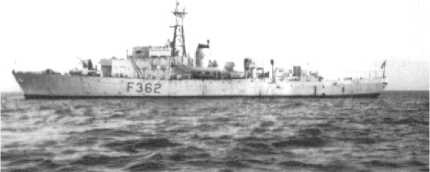
Then came sea-time, during which we were dispersed for a couple of months to the fleet. For two lucky coders this meant going out to join a cruiser in the West Indies squadron, but most of my class were dispatched to Portland to join the training squadrons of frigates and destroyers, at the rate of one man per ship. Being a Devonport rating, I was sent to a Devonport ship, HMS Portchester Castle, named after a castle near Portsmouth. The ship had been built as a corvette in 1943, but uprated to frigate when better armed; in 1952 it had a pair of 4-inch guns and squid guns for firing patterns of depth charges forward, as well as the usual facilities for firing them over the stern. In fact, it was one of the best known ships of its class, because it appeared as the second ship featured in the film The Cruel Sea, filming for which had not long finished when I was drafted to her. It was scrapped in 1958.
It was immediately clear that the captain (a lieutenant-commander) and his officers were nonplussed as to how I should be kept occupied. With only eight weeks training, I could hardly be trusted to do anything 'naval' and there was no obvious senior rating to put in charge of me.
What's more (as I found out after a few weeks), I was a university graduate and such a creature had never appeared before. In the event, I was allocated to the communications lieutenant, who was my divisional officer anyway, and he found me various odd jobs. The ship's office happened to be next to the radio quarters, so he installed me there and sighed with relief when he discovered that I had taught myself to type with two fingers on the students' union typewriter. In effect, I became an acting writer (clerk), as the ship was too small to rate a permanent writer.
|
I found typing at sea even more difficult than on land, but luckily we had the most amazingly balmy weather for almost all but the last day or two of my two months in Portchester Castle. Each ship had a copy of Queen's Regulations and Admiralty Instructions, which had to be kept up to date by pasting in new items cut out from bulletins; fortunately our copy was at least a year out of date and this job was made to spread over several days. |
The highspots of my career as a writer were the fortnightly pay days, when the first lieutenant got me to set up the pay packets ahead of the payment muster, for which he allocated me exactly the correct amount of cash he had fetched from an office ashore.
The ship's role in life was then on the classified list. At that time underwater asdic was still only being developed. Our daily duty involved a friendly submarine hiding itself in the exercise area in the Channel, whereupon we set out to hunt it with our asdic, a helicopter also going out with underwater asdic dangling below. The name of the game was to see which method of hunting was the quickest. When the submarine had been found, a signal was sent to it by throwing a hand grenade into the sea a safe distance from ship and submarine. Then we could all go home for tea!
As I was an MX (Miscellaneous) rating, I was a member of the MX mess, which comprised about a dozen men, one or two each of telegraphist, signalman, steward, cook, stores rating, electrician. The engine room ratings were right up forward in the fo'c'stle, ourselves and the seaman aft of them, to port and starboard. Broadside messing was in use, which meant that we prepared our own meals and took them to the galley for cooking. This duty was done in turn, by 'cooks of the mess', and one had to learn how to negotiate a companionway (ladder) with a tray of hot food when there was a bit more than a gentle swell running (the race off Portland Bill sets up a choppy sea on the quietest days). Having been brought up on country breakfasts, I missed a decent breakfast, but otherwise the fare was not too bad. The leading hand of the mess was given a cash allowance on which to feed us, and the lads liked to save up for a big blow out now and then.
I was a complete 'sprog', but they patiently put me right on how to 'go on'. A good sign straightaway was that they called me 'Codes', rather than using one of my own names and they continued to treat me very well, accepting my different background and lack of interest in pub-crawls. It probably helped that I did not speak with a standard English accent. Of course, they were all Devonport ratings, a system like Army regiments intended to give a sense of common identity. As well as men from the south-west of England, there was a sprinkling of Welsh and Scots and most notably Irish from the Republic. I was very surprised that, although not British subjects, the latter could and did serve in the Royal Navy as a matter of course. Lincoln was so far away from any other home town that I decided my allocation to Devonport had been a clerical error.
The week-end before I was due to travel to JSSL Coulsdon, Portchester Castle was duty ship. There was no week-end or shore leave, as we had to stand by in case any shipping or boats in the Portland sector of sea got into difficulties. This was the week-end of the great storm of 31 January-1 February 1953, which hit the east coast of England with particular severity. Even at Portland it blew a force- 9 gale in the harbour and the seaman watch had to turn out during the night to make sure the ship did not break away from the quay. Some of my messmates looked as green with anticipation as I felt, but the Sunday fortunately passed without incident.
Early the next morning I left the ship to muster with my coder classmates. A naval lorry with a high-wheel base took us to Weymouth station, the high clearance being essential, as the road linking Portland Island with the mainland was under about three feet of water. The specially chartered train took a circuitous route along the south coast, calling at Southampton and Portsmouth in particular to pick up more personnel, and approached Purley station on the London- Brighton line from the south. We had had very good views of the flooding and several times the train was reduced to walking speed. At Purley we were met by Army lorries and taken to JSSL Coulsdon, on Coulsdon Common, where at last we really began to be coder specials. For administrative purposes, the Navy had invented a department entitled HMS Victory V, and petty officer writers would turn up from Portsmouth to pay us once a fortnight, the usual RN interval.
JSSL Coulsdon: the course.
The course was to last until mid- December, fairly well sprinkled with leave periods, but our immediate horizon was the exam after about seven weeks. This determined whether we would be considered for the higher level interpreters' course, or would stay at Coulsdon on the translators' course. One could say that the course started with a flourish, as on the first day a native speaker of Russian read poetry, mostly Pushkin's, for an hour without uttering a word of English. He was an excellent reader and we wallowed in a flood of beautiful, almost musical, sounds, the like of which few of us had heard before. We were converted to the study of Russian on the spot by this demonstration of the 'Direct Method'. Our next week's lecture was even more gripping for me as a geography graduate. With the help of a wall map, the speaker took us round Europe introducing Frantsiya, Golandiya, Pol'shya, Rossiya and of course, Veliko- Britaniya. The weekly Russian lecture, with different speakers, continued right through our course and we heard many stirring stories of escapes by the Whites from the Reds, and of heroics in the more recent war.
The basic teaching programme comprised a series of 45-minute periods, alternating between grammar in a class of about 30 men (and one Waaf sergeant in our case) and conversation in a class of about 10. I was taught grammar by Peter Meades, the only British civilian tutor at Coulsdon at the time, and Katie (her formal name now forgotten) for conversation. Meades was responsible for issuing the dreaded word lists and for setting most of the written work. However, I remember one of the foreign tutors marking our early written efforts very strictly, to root out slackness in forming letters, some of which can soon become indistinguishable in the Cyrillic script. The foreign tutors were refugees from eastern Europe, including many Poles and Ukrainians and a few Russians.
I remember them gathering in excited groups across the teaching area (which comprised of huts, like everything else) on the day when the death of Stalin was announced. But it took another 30-odd years for the Soviet system to collapse and most of them must have been dead by then.
Katie stuck fairly closely to the Direct Method, our first few lessons being dominated by the whereabouts of the table, the chairs, the door, the window, and so on! She also used the elementary Russian reader written by Elizaveta Fen, which began with the unforgettable phrases about John and Mary Peters who lived in a small new house in a little garden not far from London (Coulsdon perhaps!), John being a chemist who went to work in London by train (was it the model for the Janet and John readers for 1960s children?). She was at great pains to get our pronunciation to resemble a Moscow accent and our various accents in English must have been a great trial to her. For example, the other three coders in my group were John Carter, straight from Eton, and two men called Stev(ph)ens, one a geology graduate from Swansea with a marked Welsh accent, the other a New Zealander just down from LSE. For the more difficult sounds she used a diagram to show us where we should place our tongues within our mouths. The most difficult was yeri; and if we were not careful we would reproduce her contralto version of the correct sound!
The mornings from 8.30am and 12 noon, were spent alternating twice between grammar and conversation, with half an hour for 'stand easy' (Naafi break). Afternoon routines are much less clear in my memory, but I doubt if we had much formal tuition after lunch. On the language side, there was the weekly lecture. We had a weekly sing-song with a Ukrainian, who despaired of our tunelessness and poor dramatic effort, but those who could sing well formed a good choir which met out of hours and made a recording of traditional Russian folksongs and hymns. In the last session on a Friday afternoon we were shown Soviet films, execrable both in content (apart from Eisenstein's wonderful Potemkin) and in physical quality, scratchy and squeaky in the extreme. We were struck by the puritanical thinking, especially in the film about a centre forward and his girl friend. He was so slow off the mark that someone shouted out 'Go on, mate, kiss her'. This was followed by an Education Corps officer springing to his feet, threatening the start of our week-end leave.
The first major test came towards the end of March. I caught flu and was shipped off to the Guards barracks next door to go into hospital, a measure as much concerned with slowing down the progress of infection, as my welfare. When the results came out I was only a few marks short of the threshold at which I would have been considered for the interpreters' course. Disappointed at first, I came to regard the dose of flu as a godsend. The rest of the Coulsdon course was plenty tough enough for my linguistic potential, as the early advantage of previous private study wore off.
I do not remember anybody being 'returned to unit' (an Army phrase) either at the first main test or at the second some months later. Perhaps we were comfortable and interested enough not to risk being 'sent down'. However, I also have a recollection (accurate I believe and confirmed by John Cole) from results lists set out in order of merit that the naval kursanty performed significantly better than those enlisted in the RAF and the Army. Despite its apparently chaotic methods of recruiting coders, it would seem that the Navy had done better than the other two services. Apart from the complication of RNVR entrants, it chose men at their medicals specifically for the Russian course, and not from men who had already started their National Service.
Outside Hut 44 at Coulsdon, just before 8.0am parade. We wore no. 4 uniforms for classes (white tops on the caps in summer), with Army gaiters to keep our trouser bottoms clean, and Army haversacks for our Russian class books. Standing, left to right - Vince Slade, Malcolm Morrison, Phil Mobsby, Lionel Franklyn, Roy Goddard, Mick (or Billy) Taylor, Bob Bower, Dave Sharpe, John Wade - In front - L to R - Frank Abel, 'Bungy' (Michael) Williams, Graham Young. |
Sometime in the summer of 1953 we were offered the possibility of sitting Cambridge A-level exams in Russian during the December season and many of us took this unexpected opportunity. As the Coulsdon course was basically a language course, with an emphasis on military and naval vocabulary, provision had to be made for tuition in literature and history. The literature was covered by our reading setbooks during normal tuition. These included Nikolai Gogol's Shinel (The Overcoat), Fyodor Dostoyeksky's Humorous Stories, some of Pushkin's poems, and other titles. I think it was down to the exam entrants to make their own notes of literary criticism, which many of us could do on the basis of sixth form language work. As to Russian history, evening lectures were given by one of our own number who had taken the subject as his special paper in the London history degree. I found the A-level translation papers much easier than those set by JSSL, in which I was given an A2 translator grade, but found the literature and history paper quite as difficult as in Higher School Certificate French several years before. |
JSSL: military matters.
From what I have written about Coulsdon so far, the reader might think we were attending a boarding school, but it was after all an Army camp, run by a curious mixture of NCOs and officers from all three services under the command of Lt- Colonel Black. I was never certain whether the authorities had decided that we could not be expected to learn Russian all day, five days a week, and therefore asked that we should be kept occupied in the time not so spent, or whether Black decided on a proper Army routine, which came first in his sense of priorities. However, as he was not the principal, it seems on balance that the first hypothesis wins, although there were times when one was vaguely aware of a tug-of-war.
Quite properly, I suppose, since his camp was next door to the Guards' Depot at Caterham, Black thought he should take on the nearly hopeless task of making us look smart on parade. In practice, this was almost entirely left in the hands of a regimental sergeant-major, a spare one from the Lincolnshire Regiment, who came, and spoke as if he came, from ScUnthorpe. It was nearly hopeless for three reasons. Firstly, we paraded twice daily in the classes in which we took our Russian tuition, all three services mixed together. Worse still, the pongos (soldiers) were from all manner of different regiments, with wildly differing headgear adding to the rag-tag-and-bobtail effect. Secondly, we had inevitably brought with us the drill traditions of our previous units: the Navy with its long, relaxed strides; the light infantry regiments with quick, short steps; the RAF and some other Army units somewhere in between, and so on. Finally, we only took it seriously enough to keep ourselves out of serious trouble; this did not include being bawled at and cursed and being referred to as 'educated bastards'.
So drill took up quite a bit of afternoon time. There was also a series of lectures on small arms and we were taken on the firing range. Here, Coder Special Roy Goddard surprised everybody by being good enough to compete at Bisley, from which he returned with a 'Good Shooting Badge' to wear on his right cuff. There was a healthy dose of PT, and swimming in the Guards' pool. Cross-country runs were a feature of PT and we had a good team for external competitions advised by Gordon Pirie, then representing England at long-distance running and living in Purley.
The NCOs were even brave enough to take us out in long columns on public route marches, despite our reluctance to march smartly. The length of the columns meant that the NCO did not always have a good view of everybody and in these circumstances it was a favourite trick for one rank of three (usually coders) to change step or to slow down the pace. This produced a ripple of confused movement all the way backwards from where the change had been introduced, followed by much swearing on the part of the NCO, a command to halt, and a fresh start. On one occasion the shopping parade near the Rose and Crown was the chosen spot, where we were entertained by the reaction of old ladies to the colourful language. I fancy we still sang second and even first world war marching songs - all that was to change with 'Rock Around the Clock' coming on the scene in 1957.
A well-used public footpath ran through the camp and partly for this reason we had to take turns to mount guard overnight and right through the week-ends. Apart from the men in the guardroom, one man guarded the coke store against marauding kursanty looking to supplement their barrack-room coke rations, and another guarded the quartermaster's stores which contained our food supplies. The latter was an especial irony, since folklore has it that, soon after we left, the Cook Sergeant was charged with flogging stores on the black market, his punishment including reduction to private soldier.
On Saturday mornings we were paraded as usual and divided between those who would return to our barrack huts to present them for inspection and the majority who were found jobs around the camp, such as cleaning the Naafi, the sergeants' mess, polishing cutlery in the dining room, and so on. The afternoon and the whole of Sunday were ours to use as we wished, unless we were on duty.Finally in this military section, it was announced during the summer that, following a lecture or two on 'escape and evasion', we were to have some practical experience. The plan was to take us to some distant point in closed vehicles- how distant we never knew- and turn us out with or without iron rations, the object being to see how many could get back to the camp without being apprehended by the Police or by patrols. Theoretically, we were to take no money with us. The exercise was never attempted - were we regarded as too incompetent or too clever by half? Did the Police object, did the civilian principal, 'higher authorities', or the Coronation intervene? |

‘Jack’ (Bob) Warner outside the Guardroom at Coulsdon. The pigeon holes were for our liberty ‘tickets’ when we went ‘ashore’. |
Coulsdon fell down on living conditions, although we had a mild winter by 1950s standards, so I cannot complain as much about the cold as many others the previous winter, or those who went to Bodmin. With a bit of forethought, or even modifications after opening, life could have been more comfortable and we could have been more studious in our spare time. Most of the barrack huts were concrete block structures open to the roofs, heated by a single ineffective coke stove towards one end; there was no linoleum or carpeting apart from minuscule bedside mats. Ablutions, toilets and laundry facilities were in separate free-standing blocks, dissipating their heat over the surrounding space. The furnishings were ridiculous, comprising a bed and a locker to each of the two dozen or so men, but only one chair and a table that could accommodate about six people round it. We did our homework sitting or lying on our beds, or by retiring to the Naafi, where it was often possible to find a free canteen table or a table in the quiet room. |
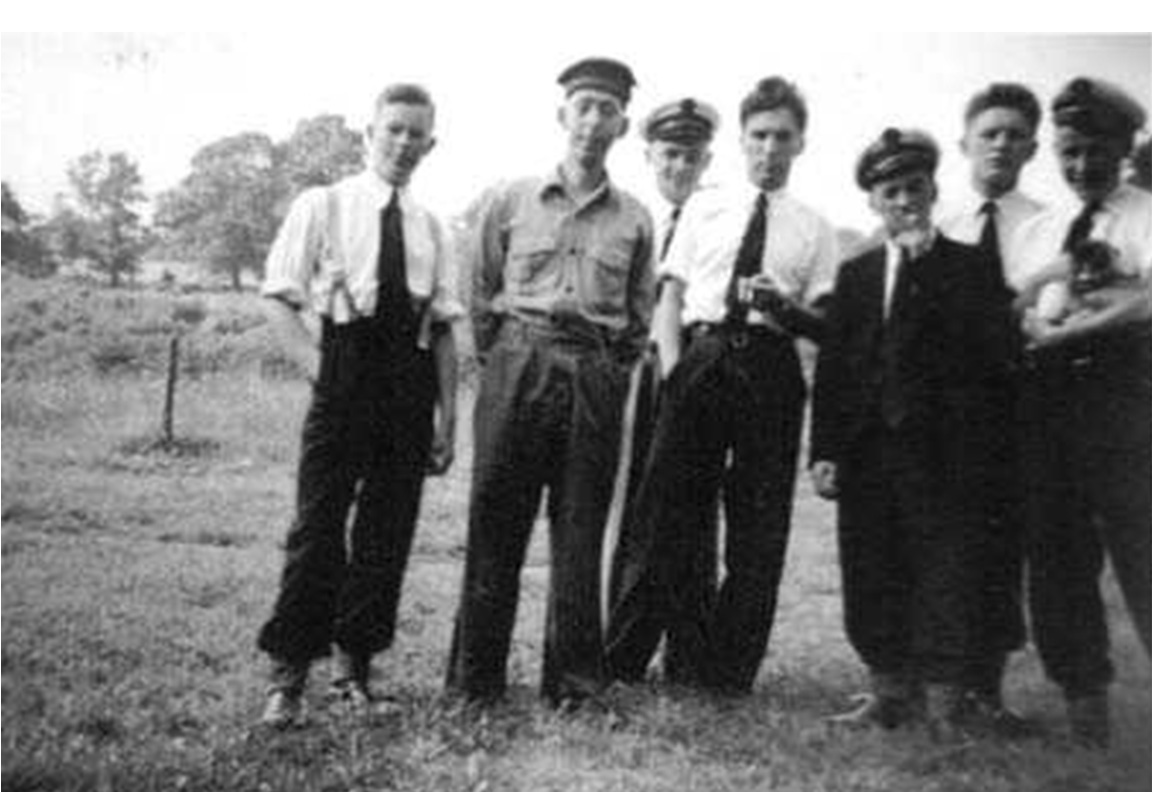
One Saturday morning at Coulsdon, outside Hut 44, the Common in the background. I had been in charge of cleaning the mess, hence No. 8 uniform, the others on a special parade. Left to Right - Gordon Morton, Dennis Mills, Roy Goddard, John Wade, Bob Bower, Lionel Franklyn, 'Bungy' Williams. |
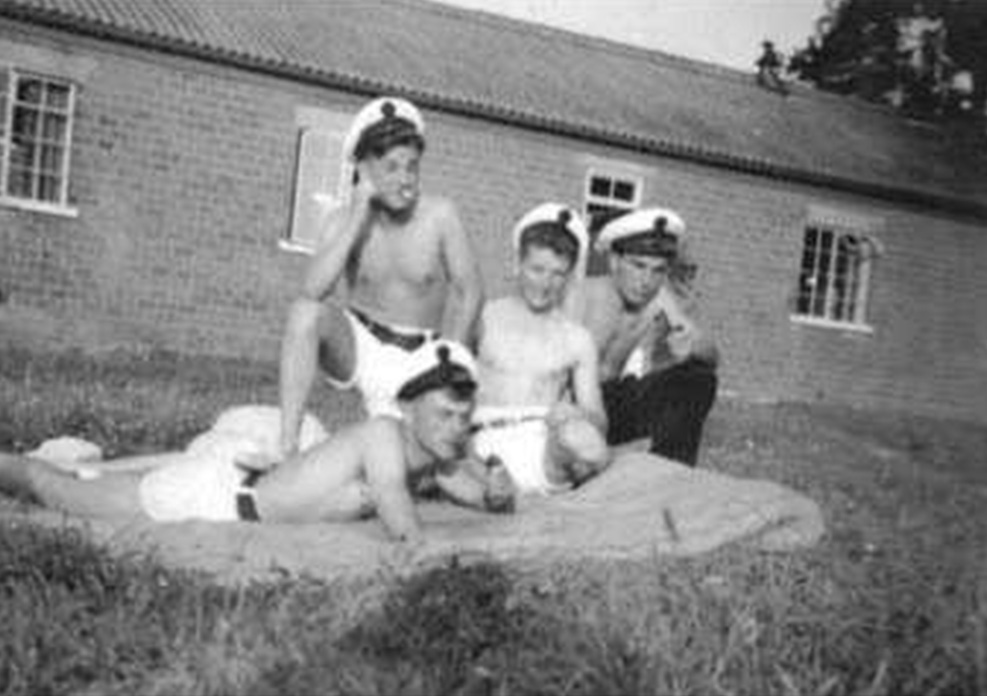
Hut 45 in the background. Left to Right - Bob Bower, Dave Sharpe (lying down), 'Bungy' Williams, John Wade. |
The food was pretty poor and the cleanliness of the cook house and dining room very questionable. When home on leave from Coulsdon the first time, I took an old bike to Lincoln station and sent it to myself to pick up at Caterham. Bob Bower and several others took similar measures. These bikes gave us additional mobility inside the camp and we were usually in the first dozen of the lunch queue of hundreds (speeding along at about 20mph, I also nearly knocked down the only naval officer we had). |
We finished work at 4.0pm and this was followed by an apology for high tea, with 'supper' at about 7.0pm. Many of us did not bother with the latter, but topped-up in the excellent Naafi, or 'ashore'. The lads straight from school were still growing, and even my age group seemed to be permanently hungry. One Saturday afternoon I went on the Green Line coach to Redhill with Private Colin Crossley, another geography graduate, just for the fun of adding to our knowledge of England. We took the chance to top up in a tea shop, where the waitress was amazed to discover that we had demolished the whole selection of seven or eight cakes she had put before us.
From time to time we would be in the hands of a 'sadistic' corporal who would wake us up at 6.0am (the official reveille time) by crashing something metallic across the dustbin lid. Such early calls were quite unnecessary, as we were not due on parade until 8.0am, and we took full advantage of the 45 seconds apparently allowed to naval ratings during which to say what we liked on being 'given a shake'. Another more regular and unnecessary irritant was the way 'they' organised the cleaning of the hut. In the Navy, daily rounds by the duty officer and duty petty officer at 9.0pm were used to make sure everything was clean and tidy overnight, with a further check after breakfast. At Coulsdon, everything centred on Saturday morning inspections, which included some of the more farcical activities faced elsewhere in the Army, such as cleaning windows with newspaper or toilet paper, polishing the dustbin lid and black-leading the coke stove, which for that reason could not be lit until lunch time. Men who went home at Friday teatime on weekend leave got out of these irksome duties. As week-end leave passes were freely available, those who could afford to travel home or to stay somewhere else did not take their share of the action. We saw the need for cleaning, but, in common with so many National Servicemen, thought the methods deliberately puerile.
The Coronation seems to have put the permanent staff in two minds. It had been decreed at a high level (the Cabinet!?) that servicemen were to have special leave (if not on duty in London - here our military incompetence paid off) and some jollifications in service time. We had the three days extra leave alright, although leaving home on the evening of Coronation Day to pass through London overnight was inconvenient, leading to trains being overcrowded by inebriated servicemen. At Coulsdon we were promised a dance with sixth form girls from the area as our guests. This did not materialise though whether for logistical reasons (15 coach loads of girls!) or for moral reasons was never discovered. But for the two remaining days of the week we had a relaxed program of inter-hut soccer and cricket matches and choices from other sporting activities, including unsupervised cross-country runs. The uncertainly about this laxity in the mind of one NCO was demonstrated by an incident during a cricket match. Nobody was umpiring, the RAF PTI having retreated indoors for a smoke and a skive. Not surprisingly, a mild debate sprang up about a possible run-out. Seeing this interruption to play, the PTI rushed on to the pitch, screaming 'You bastards came out here to enjoy yourselves and you will bloody well enjoy yourselves, or I will'.
One of the blessings of Coulsdon was its location on a good bus route as well as the Green Line service. It was only a few minutes to Purley, with a cinema and a Palais de Danse and some basic shops, and frequent trains to central London. Croydon, a bit further north, provided interesting possibilities, including an excellent public library. In summer time it was pleasant to disappear on foot southwards on to the Common without bothering to report to the Guard Room and to get lost in the Surrey countryside. Occasionally, it was known for men to disappear this way on a working afternoon, even to London. Discipline was really pretty lax, if one wanted to play the system. One week-end I successfully used a spare bed in our barrack hut to put up a school friend, who had already done his National Service and knew how to behave in a military establishment. Only those on guard duty had to wear uniform at the week-ends, so a young man in civvies passed unchallenged through the dining room for Sunday breakfast (there were about 600 of us on the camp, taking the two intakes and the three services together).
The JSSLs brought men together from a wide range of social backgrounds - not just from public and grammar schools and universities; but also from the aristocracy, Acacia Avenue, back-to-backs in northern towns, and country cottages (myself); and from England, Scotland and Wales. Class distinction was not something I was ever aware of. Bullying was totally absent and ragging was always good-natured and tolerant, partly perhaps because we saved our aggressive thoughts for the permanent military staff.
The biggest deliberate ragging event occurred when a new intake came towards the end of our time. By devious means Harry Wincott dressed as duty officer, another coder as duty petty officer and myself as an able seaman. Thus accoutred we set out at 9.0pm to do 'rounds' through the huts occupied by the new intake of coders. They were only just moving in and had kit strewn about as untidily as anyone does on such occasions. We were received warily, not to say respectfully, having got used to evening rounds. We put a good number on charges and then retreated into the dark November evening. The next day, Squadron-Leader Findlay apparently started his welcoming speech by saying 'I really am Squadron-Leader Findlay', just to make sure there was no misunderstanding.
When not grumbling about the routine, we spent our spare time chatting about the usual topics engaging the minds of well- educated young men. Lying on our beds for the lack of chairs, sometimes still with our boots on, there would be talk of amusing incidents during the day, the film showing in Purley, the choice of songs for the camp choir's recording (there was a group of very good singers who practised in my mess), what someone had read in the Manchester Guardian or The Times, cricket and football scores, women (one of us got married while at Coulsdon), and plenty of even more serious topics. It seemed to me a continuation of the Men's Common Room at university, a social life that would have been almost as enjoyable if there had been some women around. Perhaps party politics was the one neglected topic, although there was at least one future MP in my intake. Standing out in my memory are the quick repartee, the rueful determination not to 'let the bastards get us down', and an underlying recognition that we were doing something worthwhile. Two years' National Service changed my outlook as much as three years' as an undergraduate and the Russian course was central to the experience, introducing me to 'another world', one that for a time directly affected my career after the Navy. JSSL Coulsdon was a strange mixture of two essentially incompatible elements, the academic, even the intellectual, and the military, the deliberately boring, but somehow it worked. Being British, we muddled through.
Coulsdon came to an effective end more swiftly than we expected. A few days before we were due to go on leave for Christmas 1953 the railwaymen threatened to strike. Panic struck our administration - Christmas pudding for 600 men, the Colonel carving the bird? We were paraded to be told the news that we were going home four days early and travel warrant forms were issued. When we fell in again with these completed, no time was lost in collecting and processing them, men actually talked freely in the ranks. The RSM spotted Bergen on one of these forms and had the coder concerned doubling out to the front for interrogation. 'Where the bloody hell is Bergen?'. 'Norway, Sergeant-Major'. 'Why the bloody hell did you put it on the form?' 'It's my nearest railway station, Sergeant- Major'. At this point our Chief Petty quietly took the form away from the fuming RSM, saying to the coder 'Go to my office and ask for a warrant for Lerwick as usual, you'd better go home today'. And he went, flying from somewhere like Aberdeen to the Shetland Islands. We all went home the next day and the railwaymen then called off their strike! |
 All that remained of Hut 44 in 1957 when Lionel Franklyn took this photo of Dennis Mills, with the space formerly occupied by the large parade ground seen as a grassy common once more. |
Radio Training.
We had to report back to Coulsdon after Christmas just for one day, when we were made up to leading coder specials (equivalent to Army and RAF corporals) and the Navy started to pay us 12s 6d a day (0.62p), a better deal than our RAF friends who were only raised to senior aircraftsmen. The next day Army lorries were used to take the two groups of men (about 200) to Euston to catch a train for Birmingham. 'Cor', said a porter, 'what have the Navy got at Birmingham - submarines?' In a way, the answer was 'barrage balloons', for that is what RAF Wythall, on the south-western fringes of Birmingham, had been set up for in the early 1940s. For Admiralty purposes, like the men on the Navy interpreters' course in London, we were on the strength of HMS President, a retired ship moored in the Thames alongside the Embankment, used as a centre for RN Reserves.
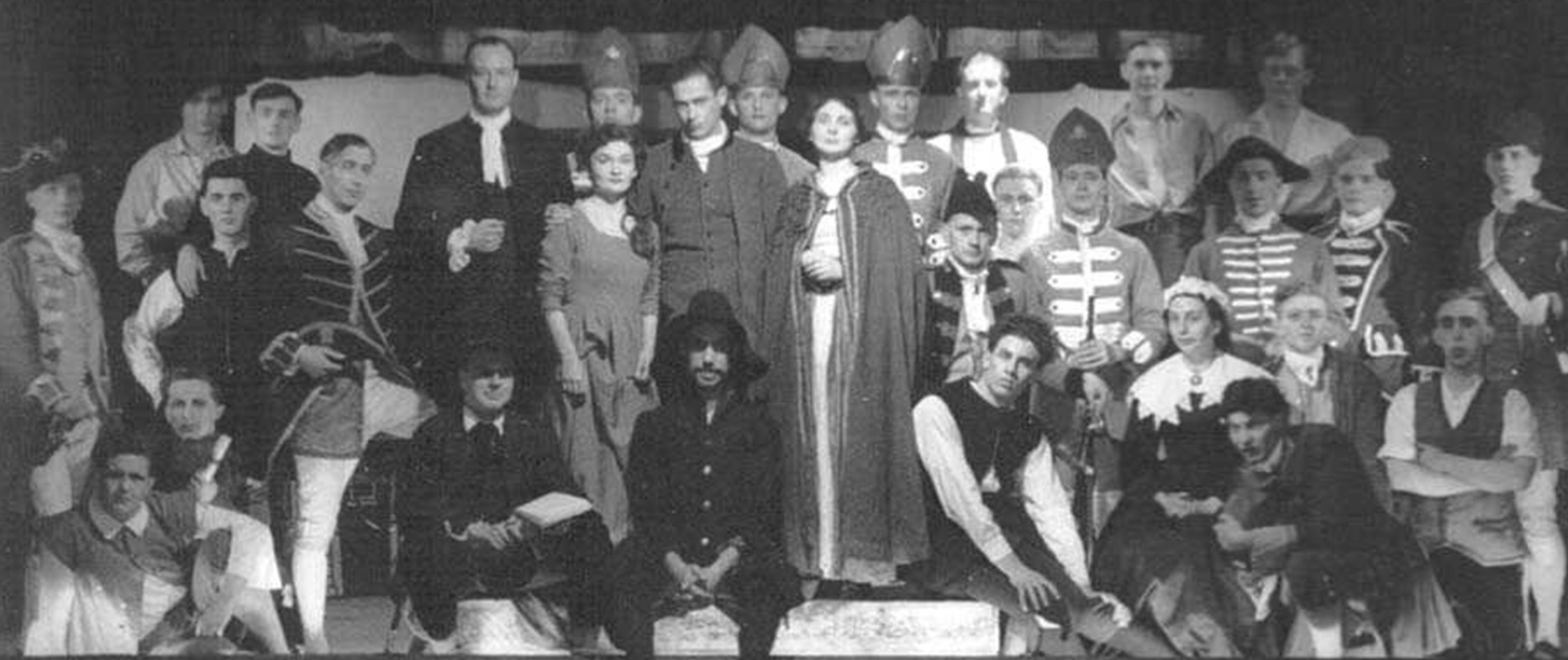
Cast of G B Shaw’ s ‘Devil’s Disciple’, produced by Bill Slater at Wythall, 9 March 1954
Back row, left to right: Graham Young, Patrick Rabbit (Crowd), Flt. Lt Foster (Pastor Anderson), Peter Barley, Harvey Ramm, Brian Shenstone (Soldiers), SAC Pete Johnson (Rev Brudenell), SACs Terry Baker and Stan Bennett (Crowd).
Middle row: Robert Jack (Officer), Bob Bird (Hangman’s assistant), Lt. Commander Goodwin (Gnl. Burgoyne), Muriel Yarwood (Essie), Flt. Lt. Nettleton (Dick Dudgeon, ie, the devil’s disciple), Marie Cooke (Judith Anderson), Alan Mitchell (Major Swindon), Keith Harrop (Crowd), Peter Davies (Soldier), Eddie Robson (Sgt.), Michael Taylor, Gordon Lumsden and Jack Darling (Officers).
Front row: Geoff Kirkbride (Hangman), Kevin Purcell (Lawyer Hawkins), Harry Kelly and Jim Martin (Crowd), SAC Dave Sherman (Hangman’s assistant), Eunice - (Mrs Dudgeon), Adam Pyke (Christie Dudgeon), Frank Abel (Uncle William) and Dennis Mills (Uncle Titus)
Men listed without rank were leading coders; the cast totalled 31.
Whereas the teaching of Russian at Coulsdon was not on the 'secret list', the nature of the course at Wythall was such, and we went there wondering if we and our families had been given security 'vettings'. Wythall was essential if we were going to do the job intended for us, but Coulsdon had been the 'main course' and now we were feeling a bit sleepy and relaxed over the 'dessert'. Our main exams were over, the word lists had gone, and we discovered that most of the radio traffic was going to be limited to a small vocabulary (weather forecasts, for example), indeed it was to be mostly numbers. We had a course in the theory of radio, which was interesting enough, but for the non-technical (as most of us were), not something that would absorb us, or that we would retain for long. Mostly it was practical training, which allowed us to go straight on to watch-keeping duties when we got to Cuxhaven.
The work was dominated by listening to recordings of actual radio messages originating from Soviet military and naval sources. My tutor was Mr Stanislavsky (a fairly common name), a little man who took his job just a shade too seriously for us - no doubt he wanted to hang on to it longer than we did ours! The room was wired up so that each man could listen on earphones to the recordings he played, message pad and pencil at the ready. Then would emerge a stream of meaningless numbers (cipher traffic), in four figure groups, spoken in staccato telegraphic tones, occasionally muffled by static, or fluctuating in volume. At the end of the exercise - perhaps five to ten minutes long, no more - the correct version would be passed round. After two or three weeks, when we had got to maximum speed (despite more difficult material), we settled down to our individual levels of competence. Many of my class mates would regularly score about 95%, whilst I was discouraged to find that 90% was an unusual achievement. I recollected the primitive hearing test in Lincoln 18 months before and recognised that my mother's scarlet fever and my own chronic tonsillitis at the age of four had damaged my hearing. Never mind, I could switch a tape recorder on as quickly as the next man.
To break the monotony we had a few other activities, such as route marches and PT and Wednesday afternoons were given over to outdoor activities. Rather than soccer, I chose (unsupervised) cross-country running. This was an attractive skive, as it made possible a long 'stand easy' in a transport cafe on the Birmingham-Evesham Road. Partly because I expected the camp 'authorities' to rumble this, I kept clear of the cafe and struck out into the attractive network of green lanes and minor roads south and west of the camp. I would walk when tiring, rather than using a shorter route and getting back early, since to do that was to break the golden rule for skiving - never finish early.
However, there was a core of serious cross-country runners from both services who trained at other times as well as Wednesday afternoons. RAF Wythall was only a small station, but it entered a team in the RAF cross-country championships, climbing up into reaches where it defeated leading bomber stations. The great day of the finals came, when it won the all-RAF cup. The men changed back into uniform for the presentation by an Air Commodore, who was staggered to find himself presenting the cup to Leading Coder Bob Bird, the 1952 Universities individual champion and the Wythall captain!
The regime at Wythall was more benign than that at Coulsdon, the food was better and the accommodation was centrally heated, the latter important as we were there in the winter quarter to mid-April. Apart from radio theory there was no homework, central Birmingham was only a half hour's bus ride away and Leading Coder Bill Slater, a RADA alumnus and a future BBC drama producer, had been retained from the previous intake so that he could for the second time produce a play. This was G B Shaw's Devil's Discipleand an analysis of the 31 cast is as follows: women civilians, three; officers, three; SACs, four; coders, 21 (including myself as Uncle Titus).
The course ended in time for some Easter leave, but instead of going straight out to Germany, where perhaps the workforce was already up to strength, we were dispersed to the signal schools, in my case at St Budeaux, Devonport. Here we had more instruction in the use of Admiralty code books and the unforgettable experience of playing with German enigma cipher machines. These were wonderfully engineered and plentiful enough for one between two men in a class of, say, 30. Another quite different highlight of the fortnight for me was provided indirectly by the visit of Princess Margaret to unveil the naval war memorial on the Hoe. Ceremonial uniform was to be worn and each branch and ship had to provide so many men. Ratings had to wear white gaiters and belts; these were not part of normal uniform and the dozen or so communications ratings involved were issued with them for the occasion. The gear had not been used for sometime, so before being blancoed, it had to be scrubbed clean. This humble task fell to me and I spent an hour and a half on the job, being pleased not to have to apply the new blanco. As we coders entrained at Plymouth to start the long journey to Cuxhaven, we saw the princess arriving in the royal train on another platform. With no disrespect to her or to the war memorial, we were relieved to escape.
HMS Royal Albert
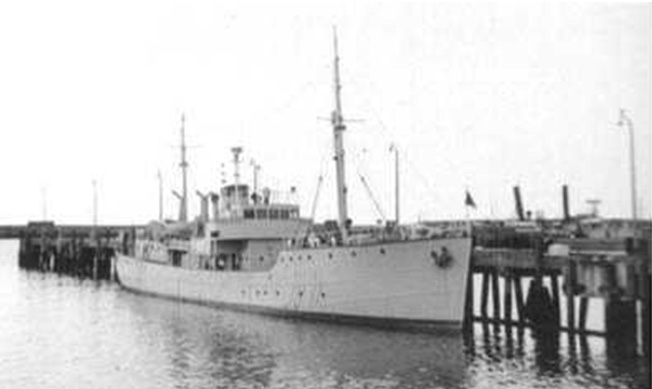
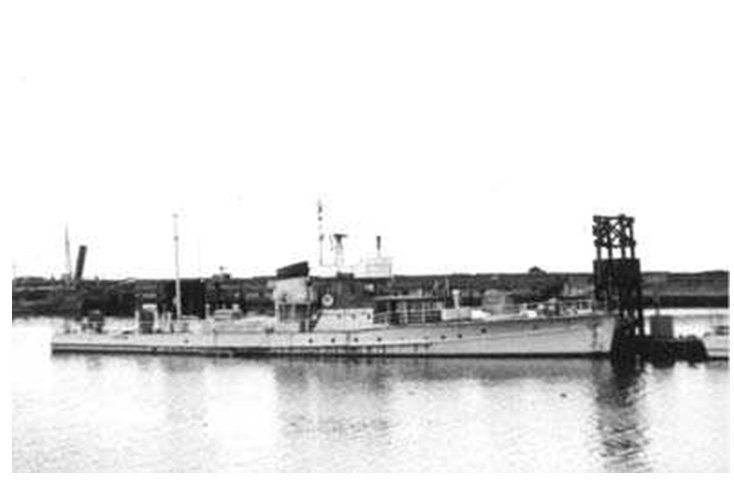
We arrived at Parkeston Quay, near Harwich on the evening of 30 May 1954 to embark in an Army troopship. To have the Army in charge of a ship seemed a contradiction in terms and one came across some very strange phrases in the signage, including 'left' and 'right', 'boat' instead of 'ship', and my old favourite: 'married families'. However, we were able to compensate for this by making fun of soldiers and airmen who came up to us and asked 'What sort of passage are we going to have, Jack?'. The use of 'Jack' made us feel like real sailors and I suspect that to a man we said 'pretty rough'. In fact, eventually, I made the same passage four times in both directions and always had a smooth sea.At the Hook of Holland we transferred from an Army ship to an Army train, one of three (I think) that ran on regular routes, ours terminating in Hamburg, after a winding route that took in Utrecht, Osnabruck, Bremen and Bremerhaven. We were then transferred to the civilian train for Cuxhaven. This modest-sized fishing port is close to the mouth of the River Elbe and on the south bank. HMS Royal Albert was at the east end of the fisch-hafen, about three-quarters of a mile from the town centre.Royal Albert was both a ship (well a launch) and a shore base. The latter appeared to have been built in the Hitler period, with good-looking buildings, much newer than any RN barracks I had seen. The Navy had taken over the E-boats at the end of the war and was still in charge of them. |
|
|
|
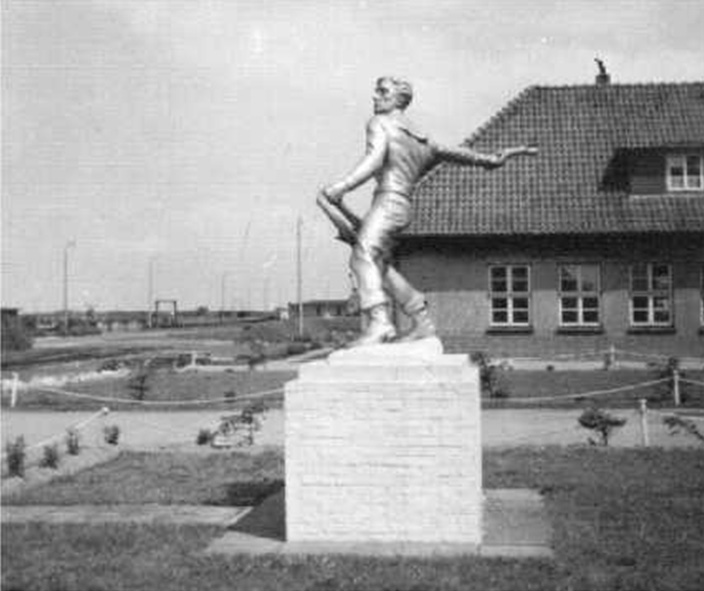
The Seegrenzschutzepolizei (Marine boundary protection police) were also there, an embryo German navy. I saw no U-boats and never worked out where their pens had been. In a prominent position stood a fine sculpture of a German sailor on a plinth labelled 'Treu und Fest'. It seemed a strange world, in which we were surrounded by the friendly old enemy whilst we listened to the new one. There was the occasional use of the E-boats for intelligence work among the Soviet Baltic Sea Fleet. Coders were not used for this purpose within my knowledge, but Leading Telegraphist Davidowicz would disappear and re-appear at erratic intervals, presumably on sorties of this kind.
|
Food was always the first consideration. For a week or two we had to put up with Army rations, but our arrival had increased the numbers of men to well over 100 and this enabled the purser to adopt direct victualling. The change in quality was immediate and marked, and was sustained by the joint efforts of the purser and the civilian German galley staff. In particular, the fish, which had been coming from Grimsby, was bought on the fish dock two minutes' drive away and tasted like fish I had never had before. Food was also plentiful and we soon learned to say 'Noch ein stuck, bitte'. Being back with the Navy, we also had the chance to take our tots of rum at lunch time each day and since we were outside the UK we could take up a ration of 600 duty-free cigarettes each month. On the other hand, there were complaints about the chemical taste of the beer in the canteen.
|

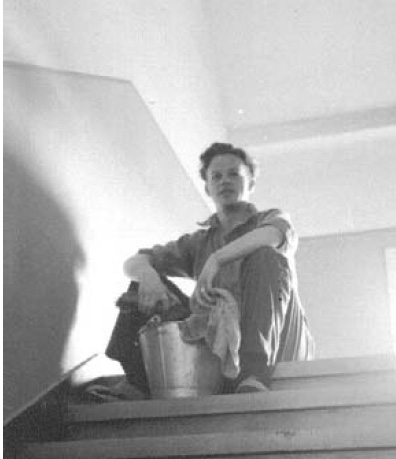
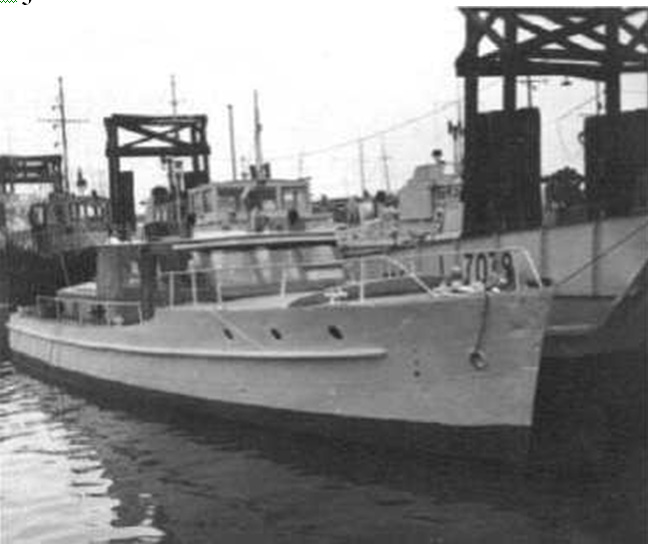
Apart from week-end passes and longer leave periods, we were free after 12 noon to go 'ashore' on the days when we were not on watch, the forenoon having been spent on 'working part of ship' - domestic chores or 'fatigues'. It was difficult to find things for us to do, although I clearly remember the morning when perhaps 20 coders were asked to polish all the cutlery in the dining hall. Without there being anyone in charge of us, we turned to with a will, anticipating that we would be dismissed after the job was finished.There was still no one in charge ten minutes after we had finished and had put everything 'in ordnung' for the German civilian staff. So we dismissed ourselves and were half way back to our barrack rooms when an angry lieutenant appeared from behind. After tearing us off several strips, he set us to work weeding the railway track - a siding that came into the base from a line that joined the fisch-hafen to the station. This was reminiscent of the Army at Coulsdon. I had not been long at Royal Albert when the Master-at-Arms discovered that I was a geography graduate and summoned me to his office to take over the issue of travel warrants for men going on leave. I became an acting writer again and did much less working of part of ship after that.It was possible for naval personnel to 'hire' a craft for the day free of charge, provided a suitably qualified crew were available. One Sunday a party of coders persuaded a seaman PO with a coxswain's ticket and an engineering branch rating ('Stokes') to take us out into the mouth of the Elbe in the PC III. Some excitement was caused by our inadvertent sinking of a navigation buoy! The photo shows that the weather was splendid; in fact it was so calm we towed a yacht back into Cuxhaven, because it was stranded for lack of wind. Lionel Franklyn and I also managed a trip to Heligoland on a German 'steamer', as trips to the dune island, recently cleared of munitions, had just started. |
|

Royal Albert: watch-keeping.
|
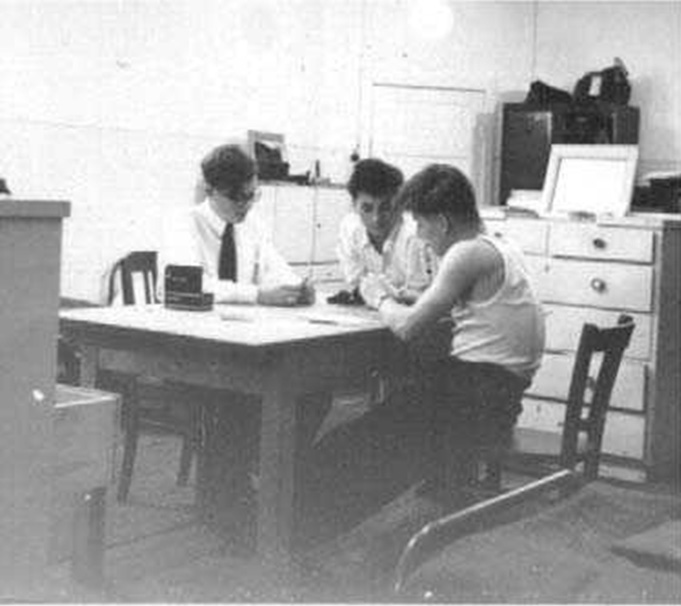
The naval watch-keeping system splits each 24-hours into seven periods called 'watches', five of four hours, two of two hours, the purpose of the odd number being to share the harder and easier watches equally in rotation between the Port and Starboard Watches (of men). In Royal Albert, a modification to this routine had been brought in to accommodate known fluctuations in Soviet radio traffic, namely that not much happened in the hours of darkness. Instead of three watches between 8.0pm and 8.0am, there were only two, the 12-hour period being split into two at 2.0am (see table below). The other local modification was that there were four Watches, each pair covering a 24-hour period in turn. Once a fortnight one pair was on 48-hour week-end leave. On resuming the following Monday at 8.0am they would start off in the opposite order to the previous fortnight, thus rotating the work on a different basis from standard practice. For five months from early May to late September this routine framed our lives, apart from the longer leave periods. The work was not physically tiring, but the irregular hours and the difficulty of sleeping when others were moving about tended to make us sleepy a lot of the time.PERIOD NAME OF WATCH 8.0am-12 noon Forenoon 12 noon-4.0 pm Afternoon 4.0pm-6.0 pm First Dog watch 6.0pm-8.0 pm Second or Last Dog watch 8.0pm-2.0 am First watch and half of Middle watch 2.0am-8.0 am Remainder of Middle watch, plus Morning watchAt any one time there would be about 15¬20 men on watch, each equipped with a naval B40 radio set (in battleship grey), an RAF set (black), a very good quality tape recorder (grey), a pair of earphones, a supply of pencils and a message pad or two. On the top of each sheet we would enter Royal Albert's call sign, that of GCHQ, date, time, etc. These message pads were sent by armed courier to GCHQ (as told graphically in Jack Rosenthal's TV-film Bye-bye, Baby), but a certain amount of material went ahead by teleprinter direct from Cuxhaven to GCHQ. The teleprinter was usually operated by the midshipman and the leading hand of the watch in a slack period during the hours of darkness. |

With one hand on the tuning knob and the other on the tape recorder switch, and unless assigned to a specific wavelength, we would search up and down our allocated wave bands listening for anything in Russian. The first priority on hearing a Russian voice was to switch on the tape recorder, then to do any necessary fine tuning (assisted by the 'magic eye' of the B40), then to start writing. There were plenty of distracting noises, often much Morse or teleprinter chatter, other voices sometimes Polish, or otherwise sounding Russian for a moment or two, and plenty of jamming (American included).
I got the impression that our scores at Wythall were used as an indication as to who should be allocated to which wavelength. Set 1 was permanently tuned to the wavelength of the Soviet Admiralty in Leningrad. My usual place, not surprisingly, was on what was probably the lowest ranking set, which did not lead to much of interest. I remember taking down the weather forecast in plain language quite often and trying to keep up with brief messages in 'grid' (cipher traffic). This was in 3-figure groups, unlike the 4-figure groups in training, so we had to adapt to a different rhythm.
There were also many tuning messages. Often the latter began with the call sign of the station or ship being called, followed by the call sign of the caller. These callsigns would usually be the names of animals or plants or trees, rather than digit-and-letter sequences. For many years now, only one of these has remained in my memory - Krokodil, because this was the Admiralty call sign, the signal was strong, and the operator had an unmistakably Russian basso profundo voice. 'Ya Krokodil', he would say, 'I'm Crocodile'.
In the tuning messages the call sign would be followed by 'Kakslyshitye menya' or Kak menya slyshitye', - 'How do you hear me'. Then would come a count from one to five, or one to ten, often reversing back to one again. Hopefully there would be a response: 'Ya slyshyu vas...' - 'I hear you...', plus 'khorosho' (well), 'normal'no' (normal) or 'slabo' (faintly). As a party trick*, I can still count in Russian, backwards as well as forwards: the operators on my wave lengths seemed to do almost nothing else but tuning and counting. And if I met Krokodil at a cocktail party, I would know him straightaway! (*Currently this is much enjoyed by my four-year-old granddaughter, Sasha, whose mother is Ukrainian and has referred to me as 'her favourite spy'!).
The work would have been more interesting if we had been briefed on the context of the messages we were recording. Obviously, on the need-to- know basis this could not be done. But there was occasional excitement, such as an incident I heard when listening to what I thought were pilots on a rocket range - they shouted 'ogon, ogon, ogon' - 'fire, fire, fire'. After finishing on the range, one pilot forgot to say 'Priyom' ('Over') and left his microphone switched on. In a happy mood, he sang traditional Soviet songs of the 'Down on the Power Station' genre. Breaking the house rules, I switched on my loudspeaker to entertain my neighbours, one of whom I discovered was listening to the enraged operator at the relevant base, who could not get through to the singing pilot to tell him to switch over, that is, to come off air. For a time we had both their voices floating across the room in competition; let us hope there was no German workman passing the window!There came a day when we had complete radio silence for something approaching 24 hours: a bit creepy, because we knew from the recent war that radio silence often preceded an offensive. Nothing happened to us, of course, and the explanation was probably early autumn manoeuvres in East Germany. Another incident occurred in relation to our direction-finding equipment, which received the strongest signals ever for almost the whole of a forenoon watch. On the stroke of 12 noon it stopped dead. It was also very quiet outside, because the German concrete-mixer working about 100 yards away had been stopped for the workmen's lunch hour. Once again, as sometimes in the late war, Teutonic punctuality gave the game away.I did not think of myself as a spy, only as involved in intelligence-gathering. I already had some familiarity with intelligence work through my regional geography course. As a recognition of the contribution made by university geography staff to the compilation of Admiralty handbooks on continental countries, after the war sets of these books had been made available in geography departments. There was little thought about how vulnerable we would have been in the event of an East-West war breaking out. Soviet agents must have spotted the large number of British servicemen with good linguistic knowledge, and although the listening station was hidden from the Elbe by the river embankment, the masts were there for all to see, alignment included.One Sunday morning, several of my messmates and I spotted from our second-floor windows in School Block the approach of three warships, steaming down the Elbe from the west end of the Kiel canal. The occasional passage of American and British warships was not unusual, but these had different silhouettes, indeed, remarkably like the Soviet ship silhouettes we knew about. Interest was aroused, men from lower rooms coming to join us. As the three ships got near, we expected that there would be the usual salutation to friendly vessels by the dipping of our flag on Navy House. Nothing moved, neither ashore nor on the ships, which sailed steadily out of sight downstream. We thought the ships were Swedish and a day or two later British newspapers (which we received early the day after publication) reported the arrival of the Swedish king in London for a state visit. Presumably, this oversight, a snub to a friendly monarch, was noted, reported, and acted on. |

|

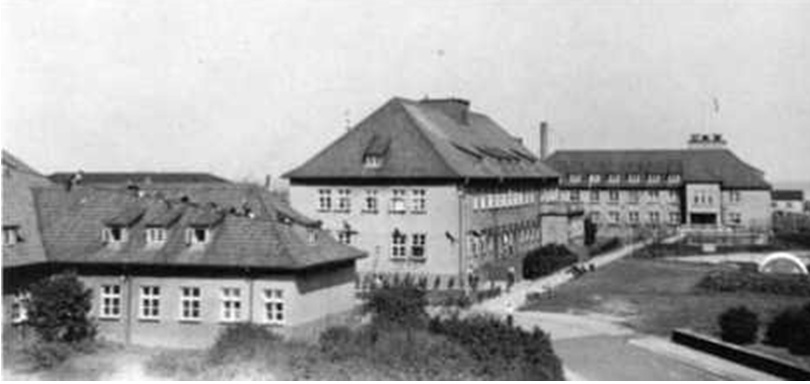

Working party outside gym
Royal Albert: going 'ashore'
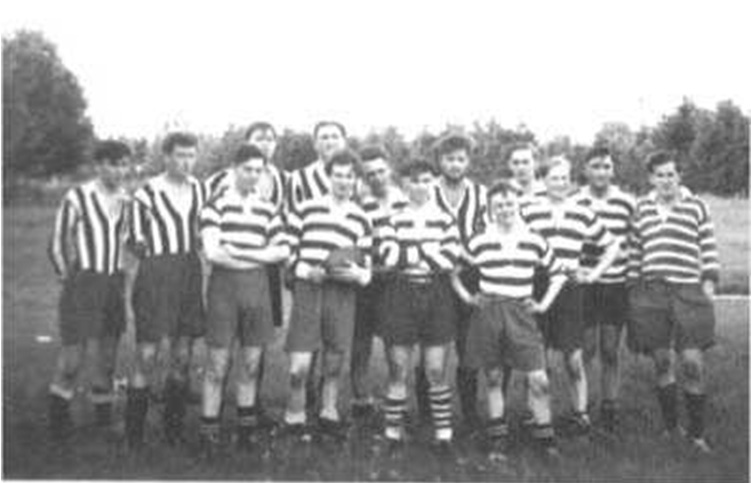
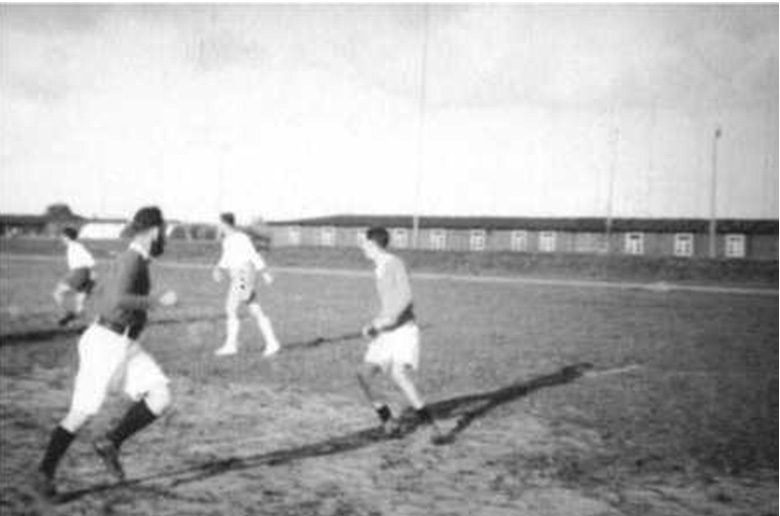
Royal Albert rugby team at RAF Utersan |
One of the pleasures of going ashore was that we could go to local coffee shops and stuff ourselves with German gateaux and try to read Die Welt. There was an American library where we could borrow books - I remember reading 1984 and several novels by H G Wells. Most of us took the opportunity to buy a camera, the Agfa Silette being a favourite - this was a 35mm camera much superior to the Kodak Brownies so many families still relied on. The Agfas generally got home free of customs duty and this brought the price down still further; mine cost £6 10s. |
The British Army of the Rhine had apparently been told by the government soon after the end of the war to encourage service personnel to learn German. In our case it meant about an hour's tuition three weekday mornings out of four, with the principal of a commercial school in Cuxhaven as tutor. It must have been tough work for him, with a different quarter of the class missing everyday (because of watchkeeping) and with men at many different levels of prior knowledge. But we were all volunteers and got along quite nicely, and he was pleased enough to invite some of us to visit his school on Saturday afternoons to give his girls some lessons in conversational English.
We were asked in turn to give short talks on any subject we thought the girls would find interesting. I sat at the back while Lionel Franklyn gave a talk, using the blackboard confidently, like he was to do 20 years later as one of my OU part-time tutors. But every time he wrote on the board, the girls giggled. Lionel glanced discreetly at his flies (we still had buttons then!). No it was not that, but the fact that he wrote with his left hand, and left- handedness was something German girls of about 18 had rarely seen, as this was one of the things 'liquidated' under the Nazis. The liaison prospered and on Saturday, 3 September (of all days!), the girls gave us a party, with dancing to records - and plenty of English conversation. Some of us became friendly with individual girls, taking them out to the pictures, or to a very sedate little night club, so we could dance again.
After I went home I kept in touch with Helga until returning to Cuxhaven for my first spell of reserve training in the Easter vacation of 1955. When we met again I asked her what she would like to do and nearly dropped through the pavement when she suggested going to see The Cruel Sea. I had already seen this film and therefore knew about the anti-German jokes, and the scene in which German sailors are taken prisoner. So we went to the cinema, with me acutely conscious of the German audience all around me watching in deepest silence. However, the German dialogue had been written to suit the audience and the worst scene had been eliminated, so, despite my unmistakably British civvies and my beard (very RN!), I was more or less relaxed by the time we came out and I walked Helga home. But as I approached Royal Albert it was getting on for midnight, which made me a bit nervous about walking past the fisch- hafen! |
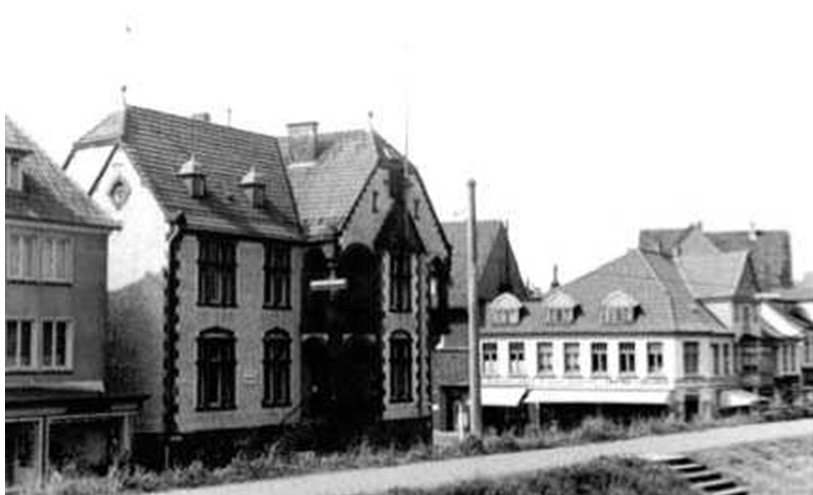
DeichstrasseThe main street of Cuxhaven |

'On the Heath'The 'road' from Berensch to Spangen |
We lived in a curious world which faced three directions at once, if not four. Although in the Navy, we were essentially civilian in outlook. For 12 hours in every 48, we were immersed in things Soviet, from which we had to be careful to switch off as we emerged from the radio station at the end of a watch. In the canteen and at the hairdresser's on station, everything seemed very British, as we used sterling notes, with Naafi issue notes for copper and silver denominations. Then when we went ashore, we had to assimilate as much as we could to German customs. If we tried out our German in a shop or a restaurant, we had to guard against letting the odd word of Russian creep in, usually, I found, a simple word, like the words for 'and', 'or', 'yes' and 'no' (This had already happened to me when speaking French during Easter leave in France). |
Going ashore in strange places in England had given me a wonderful opportunity to explore the country. For example, when at Devonport, several of us got to Helston to see the Furry Dance and when in Portsmouth I had gone on the Isle of Wight ferry for an afternoon at Cowes. I would get on a bus anytime in daylight, just to ride to the terminus and back, or to walk back a different way if there was time. So at Cuxhaven, I asked around among the German staff to see if anybody would sell me an old bike. Within days I had bought one for 27 deutschmarks, or perhaps it was 37, but at 13 marks to the £, I got it for a song. Despite the cracked ball bearing in the crank, it was good enough to get me into the town and out on to the reclaimed marsh and heaths to look at German farming.
Most of the roads were still in a bad state of repair - one had a choice between vibration from the pave, and bumps on the unmetalled sections, the roads having two distinct lanes. Sometimes the road between two villages would be nothing but a cart track. I was not unused to cart tracks, but, as on the Lincolnshire Heath, the sandy soil could be very loose and an unwary cyclist soon found himself being pitched off his bike in a big skid. By contrast, I was impressed by the number of combine harvesters I saw at work on what I could see were only peasant farms. Much later I discovered that the drier continental summer had encouraged German farm co-operatives to adopt small combines even before the war, since they did not suffer as much as English farmers from the problem of drying out wet grain. |
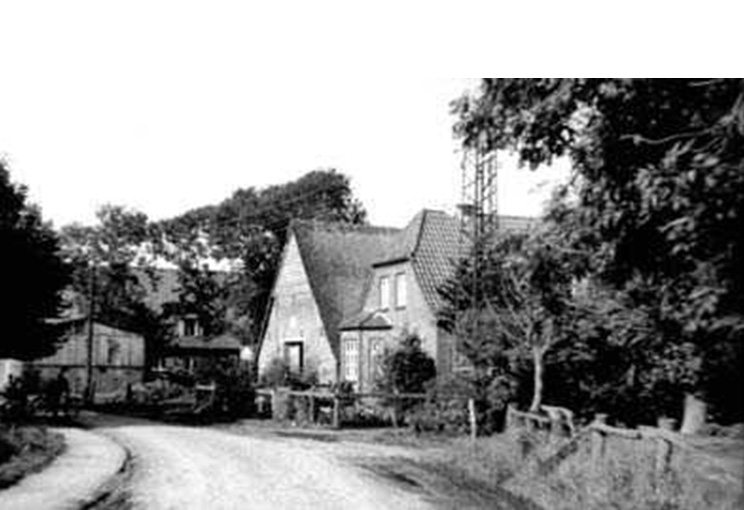
Berensch, a heath village |
Jihienworth, a marsh village, with author's old bike |
I had a week-end in Hamburg when I went to a concert given by the Don Cossack choir and a week in Copenhagen, but I saved up most of my leave to overcome a problem of the delayed call up in October 1952. After a year's National Service, I had decided that somehow I was going to return to the research I had begun for my student dissertation. The best option seemed to be to teach and to use my spare time for research, and I managed to get a place in Cambridge to take the Postgraduate Certificate in Education. As a student, I could get early release to go up at the start of the course in September. |
Not many weeks after this, however, I received an invitation to go back to my old department at Nottingham, to take up the post of research demonstrator in geography on the princely salary of £325 a year, with no fees to pay as a staff candidate for an MA research degree. The salary was only just enough to keep body and soul together - during my last six months in the Navy I was getting 17s 6d (0.75p) a day, equivalent to over £6.00 a week, or just over £300 a year, 'all found', including my National Insurance payment. I started saving a bit more earnestly! However, as a member of staff, even the most junior member in the whole university, I could not claim early release for the beginning of term. Kenneth Edwards, professor of geography, said 'Not to worry, just use your leave to turn up on the first day of term, and let me look after the week you will have to spend on getting demobbed'. And, so it was that the world turned upside down, twice over in fact. |

Demob party in train 29 September |
Demob - the world turns upside down.
According to my Certificate of Service, I left Royal Albert on Thursday, 29 September 1954. My university contract stipulated a starting date of 1 October, but that fell on the week-end, so I had until Monday, 3 October to get to Nottingham. In law, I was still Leading Coder (Special) Mills, but there on a study door in gold lettering below 'Dr C A M King', it said 'Mr D R Mills'.
For three weeks I led a double existence, receiving two lots of pay. I am sure the Navy knew nothing about it, but I have often wondered if questions were asked in the Registrar's office about the fact that it took me a month to produce my National Insurance card. In the last week of October, I went to Devonport to get demobbed and found that only Harry Wincott, from my joining-up class, was there to go through the demob routine with me. It took us a week, with little to do but wonder around from one office to another.
We were transferred to the RN Special Reserve for the next four years, with an obligation to do three weeks' service a year for three years. So it was that I found myself back at Royal Albert in April 1955, then at Royal Charlotte near Kiel in April 1956 and August 1957 (I also visited Cuxhaven in 1992 and discovered that Royal Albert had become a depot for imported Japanese cars). After the final visit to Germany we were issued with one way warrants for rail travel to RN Air Station Crail from any point in the UK, valid (from memory) until a date ten years after our discharge from National Service. I remember getting my warrant out during the Bay of Pigs crisis, by which time I was married, with the first baby on the way. I looked at it, reflected on my declining grasp of Russian, thought how pointless it would be to set out to Crail from Leicestershire (with a four-minute warning?) and decided that my place was with my wife. Fortunately, my resolve was not put to the test. (Anyway, I discovered from Secret Classrooms that Crail had closed by then).
In the meantime, the possibility had floated around that I might get a lectureship specialising in the geography of the Communist world. John Cole, Colin Crossley and I reviewed some Russian atlases in Geographical Journal and I published an article on Mackinder's Heartland Concept in Scottish Geographical Magazine, both in 1956.
The same year, John and I issued a duplicated English guide to the Geograficheskiy Atlas dlya Uchiteley Glavnoye Upravleniye (Geographical Atlas for Teachers in Middle Schools) and I went on to translate and issue the thematic chapters of a Soviet geography textbook on the Urals. It was difficult to keep these activities going against a background of research in English historical geography and teaching commitments. When no lectureship of the kind described above made an appearance, I settled for developing my MA themes in a PhD on nineteenth-century Leicestershire villages.
However, I have no regrets whatsoever about JSSL and after, experience that enriched my life immeasurably.
APPENDIX
The foregoing account was written against the general background of National Service recollections that have been cropping up on the radio, TV and in newspapers in recent years. It was stimulated particularly by reading G Elliott and H Shukman, Secret Classrooms: a Memoir of the Cold War, St Ermin's Press, 2002/3. This appendix takes up a little more systematically a few of the points raised in that text.
To put these in context, I want to make it clear that I think the book is a wonderful achievement and I am most grateful to the authors for putting on record the unusual and relatively difficult work we did, even if it was all rather tame in military terms. In particular, it was fascinating to learn about the official debate and background as to how the country was to solve the problem of having so few Russian speakers, compared, for example, with the relatively large number of German speakers available in 1939. The book is also very strong on the staffing of the JSSLs and the teaching methods employed. The authors, one with an RAF, the other with an Army background, have also done very well in attempting to strike a balance between the different perspectives of the three services, the characteristics of several different Schools (especially the translator v. interpreter contrasts), and the change over the ten-year period of their existence (The three services were together at Coulsdon and Bodmin, the RAF and Army together at Cambridge (interpreters); all three together in London (interpreters) and all three later at Crail). However, two kursanty and their contacts could not be expected to cover all the angles. So, I offer these remarks based on being a member of the 'third' service and a translator who was a member of the fifth intake at Coulsdon in 1952.
Recruitment
Pages 47-52 read as if careful selection for JSSL was widespread. My own individual experience is probably a limiting case in how hit-and-miss the process could be. I have spoken in the last few weeks to five or six of my contemporaries, and hope to summarise their experiences in a few lines. Some had heard, if only vaguely, about the Russian courses through sixth form teachers and one of these, Bob Bower, had to prompt the National Service recruiters in Cambridge (!) about the possibility of joining such a course through the Navy. Another significant common factor was the desire to get into the Navy and several made enquiries at the separate RN recruitment offices. Here it was not unusual to do an intelligence test and to have a formal interview. At Coventry, Lionel Franklyn was asked about his knowledge of Modern Languages and 'sailed in' on the strength of Anglo-Saxon and Latin! We have to remember that 1952 was only the second year of the scheme, so that men who took the initiative were likely to have formed a high proportion of the Navy kursanty.
John Cole, who was in the third Coulsdon intake, and I agree that the Navy kursanty on average got better marks than those in the other two services. Here, another basic point is that the Navy was recruiting National Servicemen only for specific purposes and on certain conditions such as RNVR service before and after National Service. By contrast, the Army and the RAF, especially the former, were obliged to take the vast majority of men who came forward or were sent to them by recruiting offices. It was only after they got into the Army or the RAF that many of these were allocated to a specific trade or discipline, often only after basic training. By contrast, both the Navy and individual coders all knew from the date of recruitment that we were destined for a Russian language course. In later years talent- spotting in Basic Training Units was probably used more, and used more successfully (p. 57).
A further point is to challenge the view that the Navy intakes were biased towards the Home Counties (p. 47). North and South Wales, various parts of Scotland including the Shetland Islands, the south-west peninsula, Birmingham and the Black Country, Tyneside, and notably the woollen and cotton towns of the North were all well represented among the friends and acquaintances I made. Such questions could only be fully resolved by means of further research that we are unlikely to see being done - and in ten years time it will be too late.
The Navy as the odd one out.
To be a National Serviceman in the Navy was certainly an unusual experience. The vast majority of us were in a limited sense volunteers - we may have got in by chance, but it was a chance we took or made for ourselves. Moreover, it was the coders who spent the maximum amount of time with the other two services. Army kursanty who were translators were never separated from the Army (even those who went to Crail?); the RAF men had experience of being with the Army (similar in many ways to the RAF) but spent no time with the Navy.
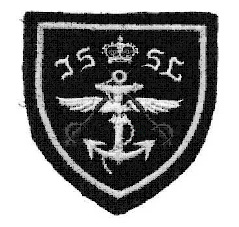
My immediate contemporaries all did 'sea time', which made us feel more strongly that we 'belonged to the Navy'. I think we were proud of this, and a not infrequent topic of banter was the rivalry between the three depots, Chatham, Portsmouth and Devonport. 'Guzz ratings are best', was a phrase brought out when someone who was not a Devonport rating was being 'chaffed'. While at Coulsdon quite a few of us bought not only JSSL inter-service blazers (the badge shown on the front cover was designed for the blazers), but also no. 1 uniforms, tailored in doeskin and adorned with gold badges.
One can judge the Navy's attitude to our skills rather more objectively. Leading Coders were better paid than the SACs who did the same course at Wythall and probably did very similar work afterwards. Similarly, men who went on to the interpreters' course were commissioned as midshipmen, or sub-lieutenants if over 21, whereas the other two services used the device of officer-cadetships, probably cheaper, and certainly less embarrassing if selection had been over optimistic. One sub-lieutenant I knew, who could not keep up with the Russian on the London course, was turned into a cipher officer and sent out to Singapore to work in that capacity for the C-in-C Far East.
A few remarks about the fifth intake at Coulsdon
This course lasted from 2 February 1952 to mid December and may have been longer (p. 74) and more relaxed than the typical JSSL course for translators. The timetable given on pages 71-72 seems to be more demanding than the routine I recall, although we paraded at 8.0am, rather than 8.30. Sunday was not the only day when we could 'leave the Coulsdon area' (p. 86), as week-end passes were freely available for those not on guard duty. We never had Sunday morning route marches (p. 84). Perhaps by the time we got to Coulsdon the Army had begun to get use to kursanty and realised it could relax a little. Phil Mobsby, despite being the group leader in charge of my hut and therefore responsible in some measure for our behaviour, was able to 'live ashore'. He had a moped, garaged in his hut leader's room, and would leave the camp each evening to go to his parents' home in Croydon for the night, returning in time for the daily parade at 8am.
I would not have described my friends as 'pimply adolescents' (p. 76), nor 'puny' (I can't find the page!). When I was in Portchester Castle, Sunday morning divisions would find me at the tall end of a rank; at Coulsdon 'dressing by height' found me at the short end. Grammar School boys (and of course boarding school boys) had been better fed and had benefited from longer years in school than most other naval ratings, especially if they had been in the sixth form. Moreover, there was a good deal of sporting prowess in our midst. On the other hand, none of us was attracted to a life of marching about and charging in full kit across country or over assault courses!
Finally perhaps, I think the book is naturally coloured by the experiences of those who went on the interpreters' course. From my standpoint, this is revealed by comparing the extra mural interests described with those I recall. The first are heavily weighted towards literature and the Arts, the second were much broader and were probably a little less serious. Among the graduates, I do not recall anyone who had read foreign languages, although among the schoolboy entrants there were plenty who were to do so. Subjects I can remember include English, geography, history, psychology, pharmacology, economics, law, theology. Also, it is worth noting that some of the schoolboy entrants were not to go to university, including some who went on two-year teacher-training college courses, one who was articled as a trainee solicitor, one who went back to his administrative job in a tyre distribution business, one back to his father's Perthshire sheep farm, and one who got a job with a timber-importing business which saw him through his working life. I also had two friends sent down from university for failing exams, one in chemistry!
Priyom!
Royal Albert. A few mementos:
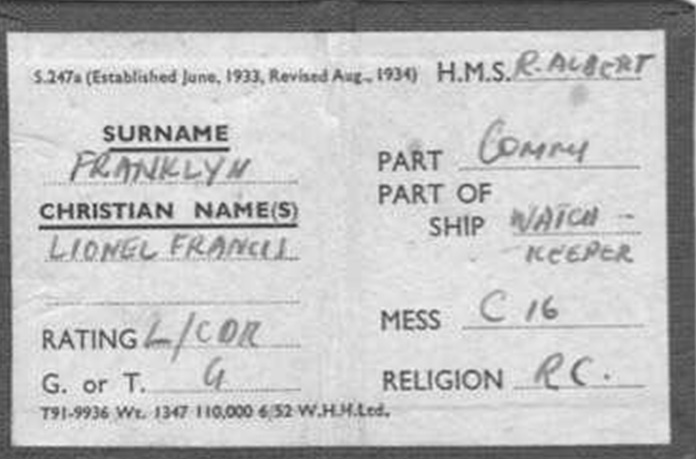 Liberty ticket (click to enlarge) |
 3d voucher (click to enlarge) |
 Ration card (click to enlarge) |
 6d voucher (click to enlarge) |